Audrey Alejandro
  • Home
  • About
  • Publications
  • Research
    • Computational Social Science meets Qualitative Research
    • Reflexivity in practice
    • Eurocentrism and the internationalisation of social science
    • The role of discourses in world politics
    • Voluntary Medical Male Circumcision
    • Climate Resilience in Dominica
  • The Methodological Artist - Personal Blog
  • Teaching
  • Consultancy
  • New Page

The Methodological Artist - Personal blog

The Case for Asking “What Is This a Case Of?”

8/7/2025

0 Comments

 
 A lot of junior researchers struggle with at least one of the following challenges when conducting autonomous research:
-“I’m told to use concepts, but how do I know which ones are relevant for my project?”
- “How do I make my work more analytical?”
- “I’m told to do a literature review, but there’s no relevant literature on my topic.”
- “How do I find literature that goes beyond my case study?”
-“I need to justify my case selection — but how?” 
- “How do I put my case in perspective?”
-“The work I admire contributes to both theoretical and empirical debates — how do I do that?”

The secret is that one deceptively simple question addresses all of these problems at once: “What is this a case of?”.
This isn’t just a philosophical musing — it’s a powerful, generative tool that can supercharge your research approach. Asking this question yields four key benefits:
1. It forces you to situate your project within a broader universe of comparable cases, leading to more rigorous case selection.
2. It helps you identify conceptual anchors for your literature review beyond case-specific sources.
3. It pushes you to develop a conceptual toolbox that sharpens your analysis.
4. It allows you to make a double contribution — both to those interested in your empirical case and to those working on broader conceptual or theoretical questions.
​
In short, asking “What is this a case of?” is a strategic, epistemological, and practical move. It transforms a descriptive project into an analytical one — bridging your phenomenon and theory to produce richer, more meaningful results.

1. Navigating the Universe of Cases: Strengthening Case Selection

One of the most valuable — and often overlooked — benefits of asking “What is this a case of?” is methodological: it helps you clearly justify and structure your case selection. In social science, cases are never self-evident; they are constructed by the researcher, defined by analytical boundaries such as time, space, the type of documents or data considered, and the actors involved.
The first step in justifying your case is to clarify what it is a case of, using concepts that anchor it in broader scholarly debates. For example, if you study how politicians argue in favour of policy X, you might explicitly want to frame your research as one instance of a broader phenomenon: the legitimation of a public policy, you would . This conceptual anchoring ensures that your work speaks to a wider audience than those interested only in your specific context, linking it to existing theories and comparative studies on similar processes.
The next step is to define the boundaries of your case — temporal, spatial, and analytical.  In the case at hand, this might mean focusing on the economic and demographic conditions of X in London between 1992 and 1998. Making these boundaries explicit clarifies the scope of your study, signals what is included and excluded, and helps readers understand the specific context within which your analysis takes place.
Once the boundaries are set, you can position your case within the broader universe of cases by identifying relevant points of comparison. This might include other public policies in London, the same public policy implemented at the national level or in other countries, or similar legitimation strategies applied to issues other than public policy. Mapping these connections shows how your case relates to others — revealing both its commonalities and its distinctive features.
Your case should also be explicitly connected to your research question, the existing literature, and relevant theories. This alignment demonstrates how your study contributes to scholarly debates: by showing that your case is both comparable to others and distinctive in ways that generate new insights. Such positioning ensures that your work speaks to multiple audiences — those interested in the specific case and those engaged in the broader conceptual or theoretical discussions it illuminates.
In many projects, there is also a “case within a case”, and each level of this nested design needs to be justified. For example, your study might be a case of an urban setting rather than a rural one, or of a city rather than another spatial or administrative unit. You might further narrow your focus to certain boroughs within London, particular age groups, or other sub-populations. Each of these choices — and the reasons behind them — must be made explicit so that readers understand the logic of your selection and the scope of your findings.
Picture
When you ask “What is this a case of?” you are also invited to consider whether typical, representative, extreme, or deviant?​ For instance, if you're studying how migrants are represented in mainstream media during elections in a specific country, is your case part of a wider trend of scapegoating by right-wing media? Or is it an unusually inclusive counter-example? Does it emerge from a national context with a distinctive media ecosystem or immigration history? How does this case relate to other cases investigated by the literature?

Don't forget that your case selection is a very important dimension of research design! To sum, it :
- Establishes relevance – Shows how the case addresses your research question and contributes to the broader literature.
- Clarifies representativeness – Explains whether the case is typical, critical, extreme, or otherwise strategically important in illustrating a phenomenon.
- Strengthens validity – Demonstrates why the case is suitable for drawing analytical or theoretical insights, reducing the risk of selection bias accusations.
- Situates the study in context – Helps readers understand the historical, cultural, political, or social background that shapes the case.
- Supports transferability of findings – Justifies why lessons from this case may apply (or deliberately not apply) to other contexts.
- Reveals methodological rationale – Connects the case choice to your data availability, feasibility, and research design.
- Preempts criticism – Anticipates and addresses doubts about arbitrariness, cherry-picking, or researcher bias.
- ou
​Demonstrates theoretical fit – Shows how the case interacts with existing theory (testing, extending, or challenging it).

2. From Case-Specific to “Instances of something”: Guiding Your Literature Review

​Another key benefit of this question is that it helps you build a conceptually grounded and strategically focused literature review. Many students conducting independent research tend to stay close to their empirical context — reading what has been written about their country, their population, or their time period. While necessary, this approach is not sufficient.
For example, if you're studying how a specific migrant group is represented in the media of a particular country, and you only read studies about that group in that country, your literature review will likely be too narrow. Your research risks remaining descriptive and disconnected from broader scholarly debates.
Instead, asking “What is this a case of?” prompts you to identify the concepts that connect your case to broader issues. If your research problem is “the discursive construction of prescribed drugs as a social health issue,” this question might lead you to concepts such as:
  • Public policy communication
  • Agenda-setting
  • Framing and reception
  • Social construction of risk and crisis
Each of these opens up access to wider bodies of literature and helps you find theoretical anchors for your analysis.
Picture
This process is iterative. As you explore the literature linked to your initial concepts, you’ll encounter additional concepts, competing definitions, and theoretical debates. Use general and specialized dictionaries of social science to clarify meanings. Internalize the concepts that resonate with your research, and start using them as exploratory hypotheses — interpretive tools that help you see your material through new lenses.

3. Becoming More Analytical: Building Your Conceptual Toolbox

​Asking “What is this a case of?” also plays a central role in building the conceptual toolbox that will guide your analysis and structure your research design. It encourages you to view your case not just as a topic or context, but as an instance of a broader configuration, process, or discursive dynamic.
The types of concepts that make up a strong analytical architecture will vary depending on your research design and field. It would take an entire textbook to map them all — and I wouldn’t presume to do that here! Instead, I’ll share an example from the type of research project I know best.
Picture
​Let’s return to the case of the U.S. opioid crisis since 1994. This isn’t just a story about drug policy (which would relate to one category of concepts — policy institutions, regulatory shifts, etc.). It can also be framed as a case of:
  • The discursive construction of public health threats
  • Moral panic driven by discourse
  • Racialized perceptions of addiction and social deviance
To sum up, a project is not inherently a case of something per se, it is you who chose what a case is a case of based on your objectives and the concepts your decide to mobilise. Depending on the lens you apply, your analytical toolbox — and your argument — shifts. And so does the theoretical community your research will engage with. For more tips on how to become more analytical check the blog post ​What is analysis ? Some tips to become more analytical,

4. Making a Double Contribution: Theory and Case Communities

​Finally, asking “What is this a case of?” enhances the reach and relevance of your work. It allows you to contribute to two scholarly communities at once:
  • Those focused on your empirical case (e.g., national politics, a social movement, a policy debate), and
  • Those engaged with the conceptual or theoretical problem that your case illuminates.
This is what transforms a good student project into a publishable academic contribution. Suppose you’re working on indigenous resistance to policy-making in Chile. You might contribute new empirical insights to scholars of Chilean politics and indigenous rights. But you can also contribute to broader debates around framing of resistances, postcolonial activism, or state-minority relations.
You don’t need to label your project as a formal “case study” in the methodological sense. But you should approach it as an opportunity to shed empirical light on a theoretical problem. That’s what makes your work meaningful to others working on similar questions in different contexts.
As Robert Yin puts it: “You should think of your case study as the opportunity to shed empirical light on some theoretical concepts or principles” (Yin 2018: 92). Similarly, Flyvbjerg (2006) reminds us that the richness of a single case often lies in its ability to reframe general ideas. Ragin (1992) goes further: the question “What is this a case of?” should be asked not once but continuously, as a way of refining what your case reveals about the world.
This mindset ensures your research has both depth and reach — it speaks to the particular while also resonating with the general.

In Conclusion: A Compass for Research Autonomy

When you're navigating the complexities of an autonomous research project — especially in an interdisciplinary setting — it's easy to feel stuck or uncertain. How do you move from topic to theory? From data to analysis?
The deceptively simple question “What is this a case of?” can serve as your compass.
It helps you:
  • Justify and contextualize your case selection
  • Construct a meaningful and strategic literature review
  • Build a robust analytical framework
  • Contribute to both your empirical and theoretical communities
More than just a clarifying question, it's a generative method — a way to think, structure, and communicate your research with greater clarity and analytical depth.

Reference

​Flyvbjerg, B. (2006). “Five Misunderstandings About Case-Study Research.” Qualitative Inquiry, 12(2), 219–245.
Ragin, C. C. (1992). “Casing and the Process of Social Inquiry.” In C. C. Ragin & H. S. Becker (Eds.), What Is a Case? Exploring the Foundations of Social Inquiry (pp. 217–226). Cambridge University Press.
Yin, R. K. (2018). Case Study Research and Applications: Design and Methods. Sage Publications.
0 Comments

分析的定义,以及一些“提升分析能力”的小技巧

10/21/2022

0 Comments

 
如果作为学生,你曾被告知:你的研究“描述性太强”,你需要“更具分析性”;
 
如果作为一名教师,你曾告诉你的学生:你们的作业“描述性太强”,缺乏“分析深度”。
 
那么,你应该来读读这篇文章。

Pictureseriykotik1970-房间里的大象
事实上,尽管我们普遍鼓励让作业和研究论文“更具分析性”,但老师可能从未让学生知道,什么是好的分析标准。分析,可以说是社会科学殿堂中的一头大象,包括所有的那些带有“数据分析”字眼的相关课程——例如我所开设的“话语分析”。

那么,什么是分析,以及要怎样才能实现良好的分析工作?

什么是分析?

分析是一个转化的过程:原始数据和信息本身并不具有意义,是我们通过分析的过程赋予其意义。
 
分析也是一个创造的过程:我们通过分析所创造的是,关于世界的新话语,它帮助人们以不同的方式感知世界,从而理解他们在阅读我们的研究之前,不知道或不理解的事情。
 
但分析是如何生效的呢?分析又是如何使世界变得有意义的呢?笼统地说:分析,通过聚焦、整理、命名以及建立范式与关系,来帮助其他人建立对这些范式与关系的感知,从而以不同方式理解世界。
 
有一个关于分析的比喻很好,那就是天文学家和其他观星爱好者识别星座的工作。天空布满了星星,但是尽管如此,有些人还是在天空中画出了图案,给这些图案命名,甚至围绕着这样形成的形状创造了一系列故事。这种感知天空的方式代代相传,被人们传授并写在书上,了解过这些知识的人在看星星的时候,都会不自觉地注意到星座。

Picture
以下,是来自方法论专著中的两个关于分析的定义:
 
“从字面上看,分析是将复杂的东西‘分解’成较小的部分,并以这些较小的部分的属性和它们之间的关系,来解释整体” (Robson 2011: 412)
 
“分析是给数据带来秩序的过程,它将已存在的东西组织成模式、类别和描述性单元,并寻找它们之间的关系;‘解读(interpretation)’涉及在分析中赋予意义和重要性,从而解释模式、类别和关系...”(Brewer 2000: 105)
 
这些定义,突出了分析工作中的双重过程。一方面,分析工作是对复杂混乱的现象进行分解和简化;另一方面,分析工作会在选定的元素之间建立模式,以产生一种解释世界的新的混合思路。
 
在研究的实际操作中,一个小时的访谈,转录记录可能会多达40页纸,而10个访谈的转录记录,就相当于400页纸。我们需要将我们的材料分解成可管理的部分,并专注于某些元素而放弃其他元素,以便我们能识别出隐藏在这些数据中的最有趣的知识。

这是否意味着万事俱备?

Picture
作为社会科学家,从我们的数据中创造任何意义和话语是可以的吗?我说过,分析是一个创造性的过程,但这是否意味着可以创造一切?
 
答案当然是否定的。意义不是原始数据所固有的,而是研究者在培育经验材料的过程中,与其共谋的结果;因此,这一观点并不意味着从社会科学的目的出发,我们能从数据中随意创造任何话语。
 
针对我们需要怎么做才能实现良好的分析的问题,我们需要制定一些明确的标准,才能帮助我们确保我们的分析目标处于正轨。总结一下就是说:分析的目的是在基于经验数据的基础上,产生一个令人信服的证明,以描述、解释和解读一个社会现象

分析的基础标准:“分析的车轮示意图”

实际上,上述定义的每个词都有其重要性。在下面的“车轮状”示意图中,我对分析的这个定义进行了详细的阐释,以明确良好分析的标准。
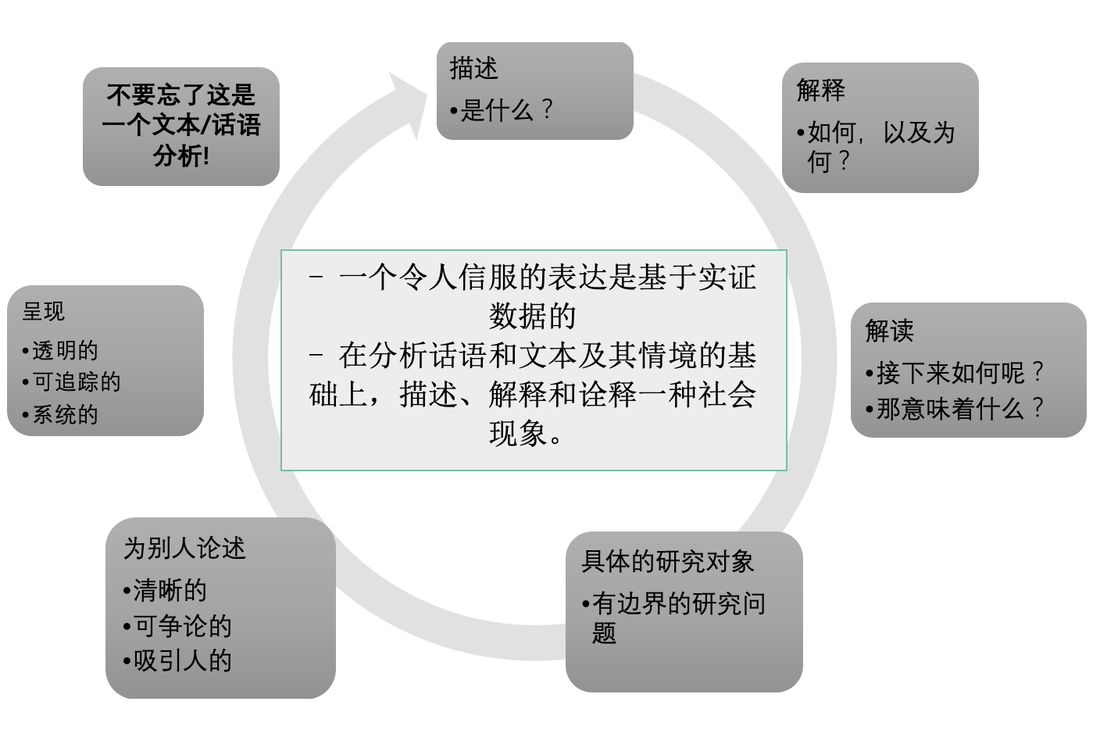
Picture
让我们进一步解读这些标准:
  • 描述:
​即为讲述清楚发生了什么事?记得确保在描述证据之前不要妄下结论。
  • 解释和解读:
对经验材料的描述是分析工作的一个必要层面,但这还不够。读者需要我们再往前走一步,向他们解释正在发生什么。根据我们的研究问题,举个例子,它可能是情况背后的原因、它们出现的条件、行动者如何在不同情境中对其进行意义的解释等等。我们需要超越简单地描述数据中的内容,通过将我们的材料与现有的理论和文献联系起来,综合解释和解读我们所审查的议题和情况。
  • 具体的研究对象:
通过选择相关材料进行分析,为研究问题提供答案。我们需要的,只有与分析相关的材料!我们有一个目的,就是我们的分析需要坚持与研究对象相关。我们的数据中会有一些有趣的东西,但并不直接回答我们的研究问题,此时,我们必须无情地牺牲掉它们!意大利面非常好,但如果我们是要去烤蛋糕,我们就不要把意大利面放进蛋糕里,否则我们就会把蛋糕弄坏,前功尽弃。总结一下就是说:我们的数据中可能有一些非常有趣的东西,但如果它们脱离了我们具体的研究主题,它们就需要被淘汰。
  • 为别人的论述:
分析工作,不是我们为自己写数据总结,它是我们传达给别人的东西。它需要清晰和具有吸引力,它是一项论证工作,我们需要说服读者;想象一下,我们正试图说服我们认识的人!
  • 呈现:
实现令人信服的分析工作的一个非常好的方法,是呈现我们分析的严谨性,创造一些不仅仅是能让人产生深刻印象的东西。我们需要超越择优挑选的轶闻般的案例,争取使我们的论证变得透明和可追溯,使读者能够理解我们是如何得出我们的解释的。我们需要对假设、程序和步骤提供一个清晰的说明,从而努力实现一个系统性的论证。我们还需要制定有步骤的分析策略和程序,并始终如一地遵循,这也意味着我们要用同样的分析框架和同样的问题来处理我们的所有数据(例如我们的所有访谈记录)。


我们每个人都有天然的优势和劣势。例如,我们中的一些人在清晰地表达他们的论点方面没有问题,但在使他们研究课题环环相扣方面却很费劲;也有人擅长提供丰富的解读,但却不太能呈现他们是如何得出这些结论的。我们需要做的,首先是了解清楚哪些分析维度是我们的弱点,或者哪些维度是我们经常会忽视的,随后,将我们所意识到的我们的劣势作为优先事项而加以努力。
 
“车轮状的分析过程示意图”,或许可以作为一个罗盘来指导我们的工作,使其“更有分析性”,而使用这个示意图检测我们研究的关键时刻,是在我们完成第一稿之后。我们可以把车轮中所标注的流程作为一个检查表,把它的不同要素与我们迄今取得的结果进行比较。我们是在提供解读,还是仅仅描述数据中的内容?我们是把我们的分析作为自己的总结来写,还是作为旨在说服听众的论述来写?我们需要在这个车轮状的示意图与我们的分析之间反复检查

This article is also available in English here, and as pdf.
Puede leer el artículo en español aquí.
0 Comments
<<Previous

    Author

    Audrey Alejandro

    Archives

    August 2025
    October 2024
    March 2023
    October 2022
    September 2022
    July 2022
    November 2020
    September 2020
    December 2019

    Categories

    All
    Analysis
    Case
    Check-list
    Coding
    Creativity
    Literature Review
    Online Teaching
    Poetry
    Qualitative Data
    Research Design
    Research Question
    Research Topic
    Self-assessment
    Strike
    Thematic Analysis
    Writing

    RSS Feed


Audrey Alejandro (2018-)
​Follow me on Bluesky, Twitter, Research Gate and Academia

  • Home
  • About
  • Publications
  • Research
    • Computational Social Science meets Qualitative Research
    • Reflexivity in practice
    • Eurocentrism and the internationalisation of social science
    • The role of discourses in world politics
    • Voluntary Medical Male Circumcision
    • Climate Resilience in Dominica
  • The Methodological Artist - Personal Blog
  • Teaching
  • Consultancy
  • New Page